
By the Crown Trim Roofers team · Published · Updated
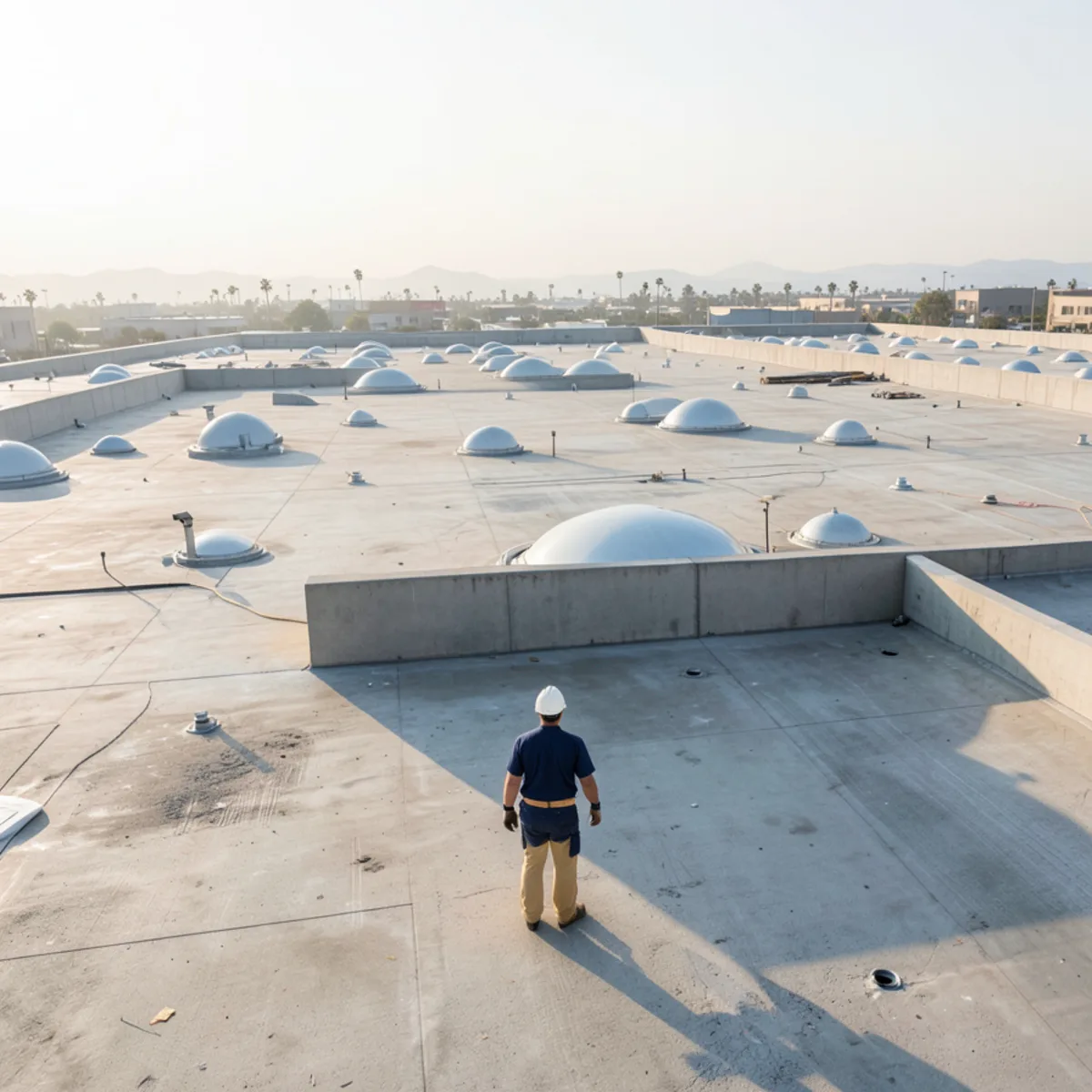
Facility managers get the call from the warehouse floor: water over the pick aisle, a puddle under the rack, a wet pallet of paper goods. The instinct is to send someone up above the spot. That usually fails. Our warehouse and industrial roofing page covers what we do on these buildings. This post covers the thinking behind a trace. It also ties into our broader commercial roofing service area.
Why is a warehouse leak so hard to locate?
A big low-slope roof is a large flat surface with very little fall. Water that gets in does not drop straight down. It runs along whatever it finds first.
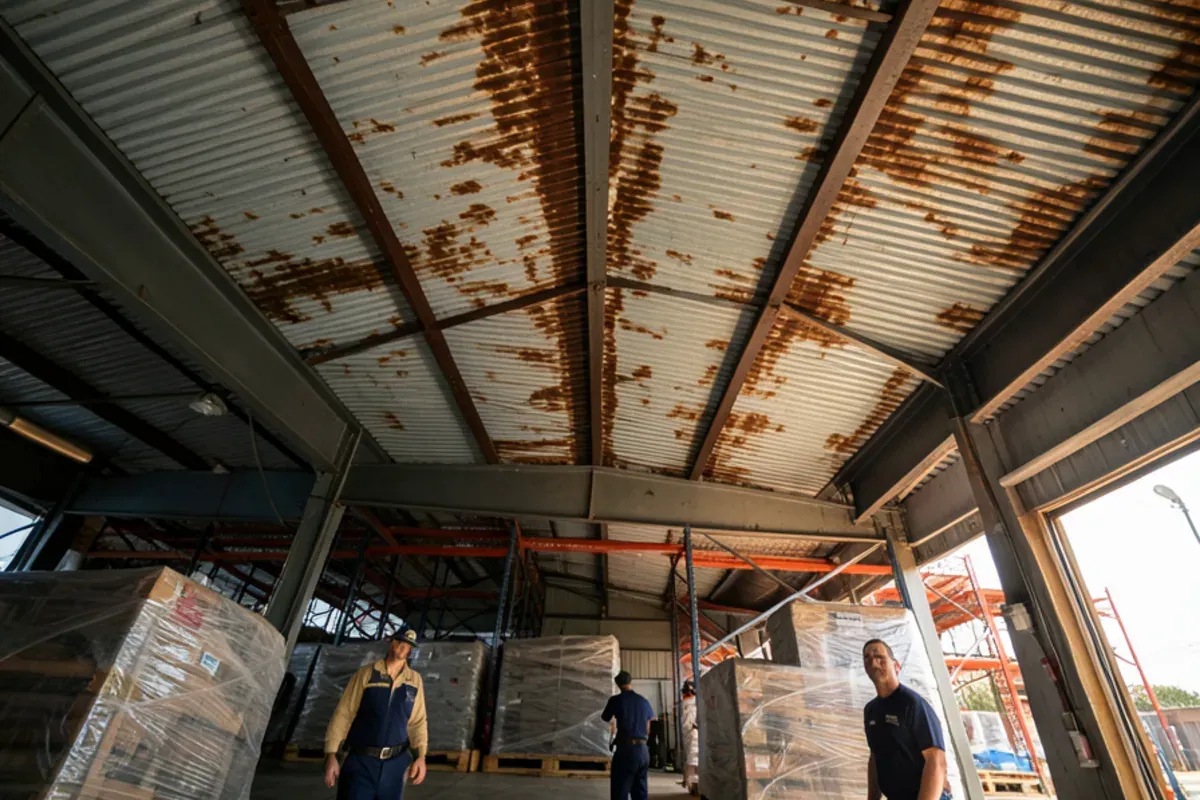
- On a steel deck, it flows down the corrugated flutes and drips at a lap or fastener, sometimes 20 or 30 feet from the opening.
- On a wood panel deck over beams, it follows purlins and glulam beams and can show up at a connection.
- Between insulation and membrane layers, it spreads sideways and soaks foam or fiberboard before reaching the deck.
Add the noise of a working building. Condensation from cold ductwork, a leaking rooftop air unit and a failed sprinkler all look like roof leaks from below. A good first step is to decide whether the water is coming from the roof at all.
How do you trace a leak on a large roof?
No single method works on every roof. A careful trace layers them, from cheapest to most specialized.
- Interview and interior survey. Note where and when water shows, then map the stains on deck flutes, joists and insulation from below.
- Roof walk. Check drains, curbs, skylights, wall joints and penetrations in the area upslope of the stains, and photograph each defect.
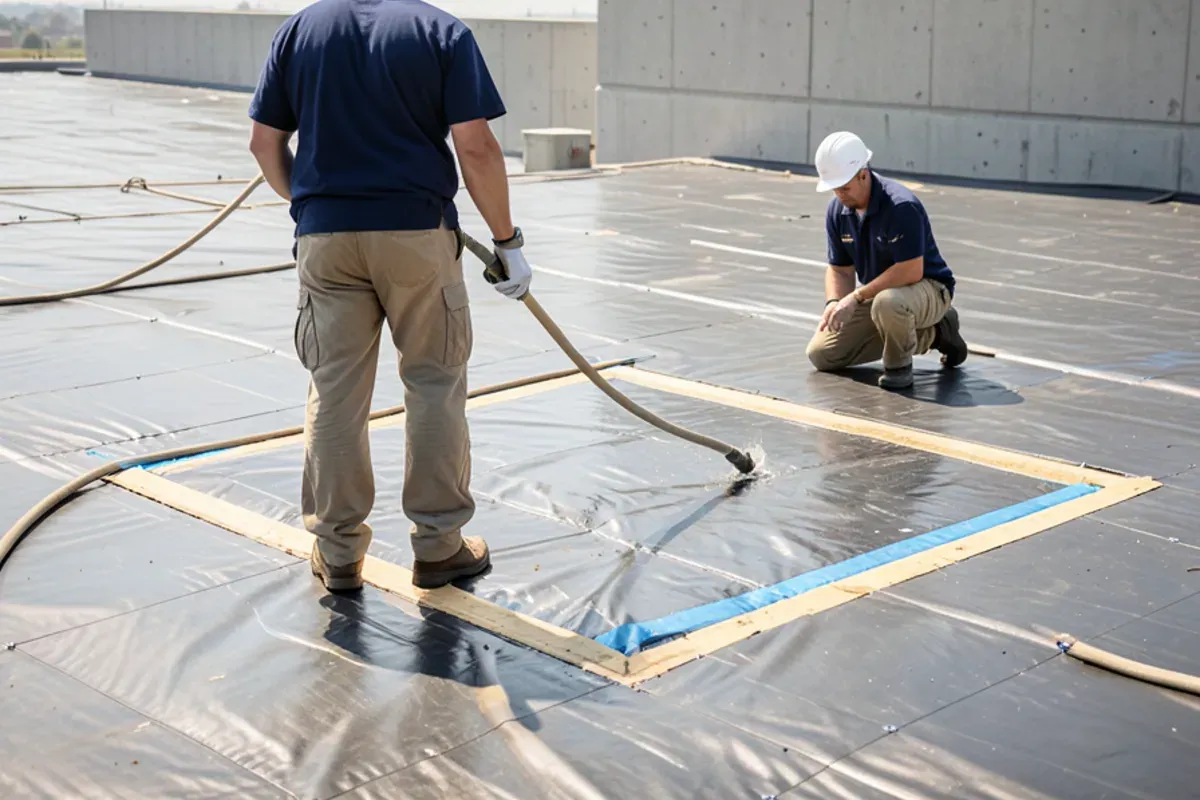
- Controlled water test. Wet one small section at a time, starting low and working uphill, while someone watches inside. When the drip starts, the last area wetted holds the entry point.
- Moisture survey. Infrared imaging, covered by ASTM standard C1153, can show wet insulation under a membrane. It shows where moisture sits, not where it got in, and results depend on conditions, roof type and the operator, so cores or probes confirm it.
- Electronic leak detection. On some membrane roofs, a low-voltage method can locate breaches in the membrane. It needs the right assembly and set-up, so it suits stubborn cases, not every call.
The trade-off is time against certainty. A hose test is cheap but slow on a big roof, and the specialized methods cost more but can save repeat visits. We tell you which step we recommend and why.
What can a facility manager do before the roofer arrives?
A few records speed up the trace more than anything on the roof.
- Photograph each stain with a date, and mark its edge in pencil or tape so you can see if it spreads.
- Note the weather. Rain only, rain with wind from one side, or leaks after a dry cold night all point to different causes.
- Protect inventory. Move pallets, cover what you cannot move and keep forklift routes clear of drips.
- Check the ceiling area for equipment. Rule out a rooftop unit's condensate line, a sprinkler leak or cold ductwork sweating.
- Stay off the roof. Plastic skylight domes and old panels cannot carry a person, and a fall is a far bigger cost than a leak. Leave access to trained crews.
How does a tilt-up building leak differently?
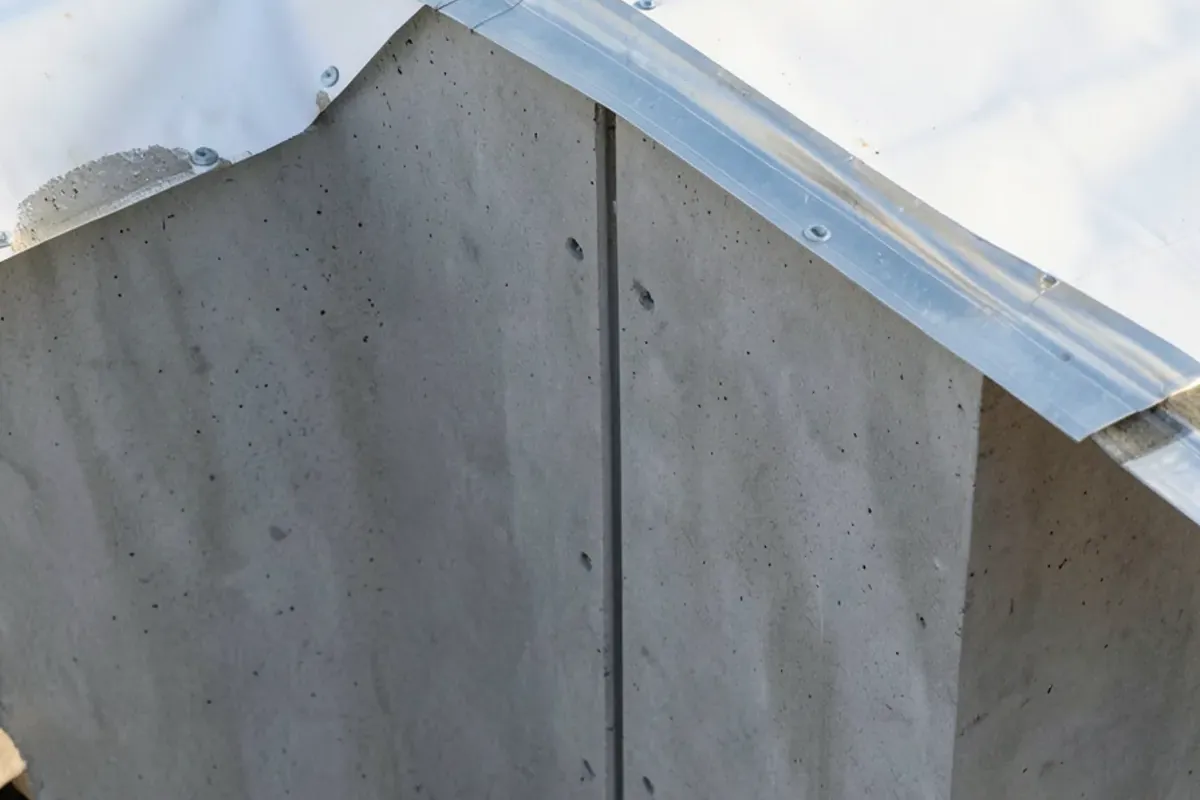
Tilt-up construction raises concrete wall panels and ties the roof into them. Lots of Southern California industrial space is built that way, including the older industrial districts around Torrance. A tilt-up roof meets its walls along a long perimeter, and that edge is a prime leak line:
- Counterflashing and reglets. Metal laid into or over the wall can pull loose or lose sealant.
- Panel joints. Vertical joints between concrete panels can open and let water behind the flashing.
- Parapet caps. A cracked cap or open joint drops water behind the membrane edge.
- Roof-to-wall connections. Movement between a stiff concrete wall and a flexible roof breaks seals over time.
Tracing a tilt-up leak means walking the perimeter slowly and checking each of these, not just the field of the roof.
What are the usual suspects on an industrial roof?
Most trace results land on a short list. Work through it in this order:
| Suspect | Why it leaks | Quick test |
|---|---|---|
| Roof drain or scupper | Clog backs water onto the membrane; failed drain flange | Look for ponding and debris; flood-test the drain |
| Skylight curb | Cracked dome seal, failed curb flashing | Inspect the base and the dome edge |
| Wall and parapet | Open counterflashing or panel joint | Check sealant, lap and cap |
| Penetrations | Cracked pipe boots, open conduit, unsealed unit curbs | Walk each one and probe the seal |
| Seams | Open lap in membrane, lifted edge | Probe the seam with a blunt tool |
| Deck or fastener | Backed-out fastener, corroded metal | Look from inside with a light |
A systematic walk usually finds more than one defect. Fixing only the obvious one means the roof leaks again next storm.
When is it a drain problem?
A roof drain clog is a frequent cause and an easy one to miss until it rains. When water cannot leave, it climbs. Even an inch or two of standing water finds every pinhole and open seam. Look for ponds around drains, mud lines on the membrane, and debris piled at the downslope side. On large roofs, check that internal drains and their piping drain freely. Overflow scuppers in parapets should be clear and unobstructed, since they are the safety valve. Our post on ponding water on a flat roof describes how to judge it. Drains also make an easy place to start your commercial roof maintenance plan.
Are skylights causing the leak?
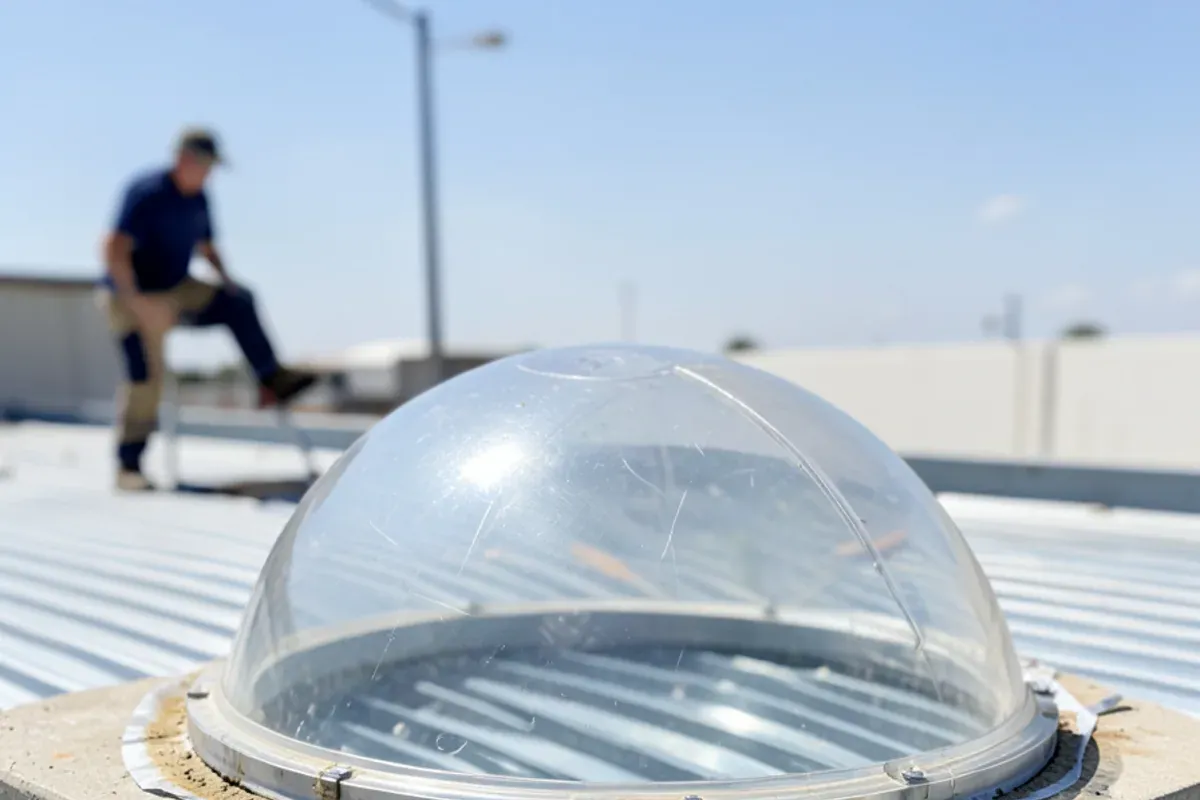
Commercial skylight leaks are common on older industrial buildings. Plastic domes get brittle in decades of sun and crack at the edge. Sealant at the curb dries and splits. The curb flashing was often lapped poorly the first time. Water that enters at a skylight can run down the ceiling steel and show up elsewhere. Options range from resealing and replacing the dome to re-flashing the curb or removing the skylight and closing the opening. If skylights are old and numerous, replacing them all in one go may be cheaper than chasing leaks one by one.
What do we do when we arrive?
We start with listening. Where is the water, when does it show, and has it changed with wind direction? One Google reviewer described a leak on a Torrance rental property that was tricky because it only showed up when wind and rain came from a certain direction. That detail is just the kind of clue that points to a wall joint or an edge. We then walk the roof, photograph what we find and show you the pictures. We explain repair and replacement options in plain terms, and we start with a repair when a repair will do.
Low-slope roof repair choices depend on the membrane: patches and seam reinforcement for single-ply, mastic and fabric for built-up, coating over sound sections. Our post comparing TPO, torch down and hot mop roofs helps with the vocabulary. Large sections that have failed through may point to commercial roof replacement.
Patch, coat or replace?
After the trace, the choice depends on how much of the roof is still sound. A few defects on a roof in otherwise good shape call for targeted repairs. If the membrane is sound but worn, a restoration roof coating may extend its life, provided the insulation underneath is dry. If core samples show wet insulation across large areas, or repairs keep reappearing in new places, replacement may cost less over time than another round of patches. We lay out those options with photos and a repair-first recommendation when a repair will do, so your maintenance and capital budgets can be set with real information.
Serving the industrial belt
Carson, with its large warehouse and distribution buildings, sits within our service area, and we reach it from our Torrance base. See our Carson page for details. Same day or next day service is available for active leaks. Call with the building address, roof type if you know it, and a description of where the water appears inside.